
We’re excited to introduce
@graphql-tools/external-fragment-loader,
a new package in GraphQL Tools that makes sharing GraphQL
fragments across packages easier!
The loader resolves missing GraphQL fragments by following direct and transitive dependencies in
package.json. It loads the external fragments your package needs.
Why we built it
At Yelp, we have a large monorepo where GraphQL fragments are shared across
packages. Although we try to
avoid reusing fragments directly,
they still need to be imported and spread into page-level operations. An operation in one package
can use a fragment from a dependency listed in package.json. That fragment can, in turn, use
fragments from other dependencies.
Previously, we had to manually maintain a list of files containing these external fragments, both to assemble complete GraphQL operations for execution and to run GraphQL Code Generator. Adding a fragment dependency meant updating the list with its file and the files containing any fragments it referenced transitively. As packages evolved, keeping the list up to date became tedious.
For example, a package might use a fragment named FragmentA from a shared package. Its file must
be added manually to the consuming package’s list. If FragmentA starts referencing FragmentB
from another package, the list must include that fragment’s file too, even though the consuming
package’s own operation hasn’t changed.
Here is an example of a manually maintained list:
Loading fragments from package dependencies automatically
The external fragment loader resolves missing GraphQL fragments by following direct and transitive
dependencies in package.json. It loads only the external fragments the package needs. In the
example above, it finds both FragmentA and FragmentB automatically.
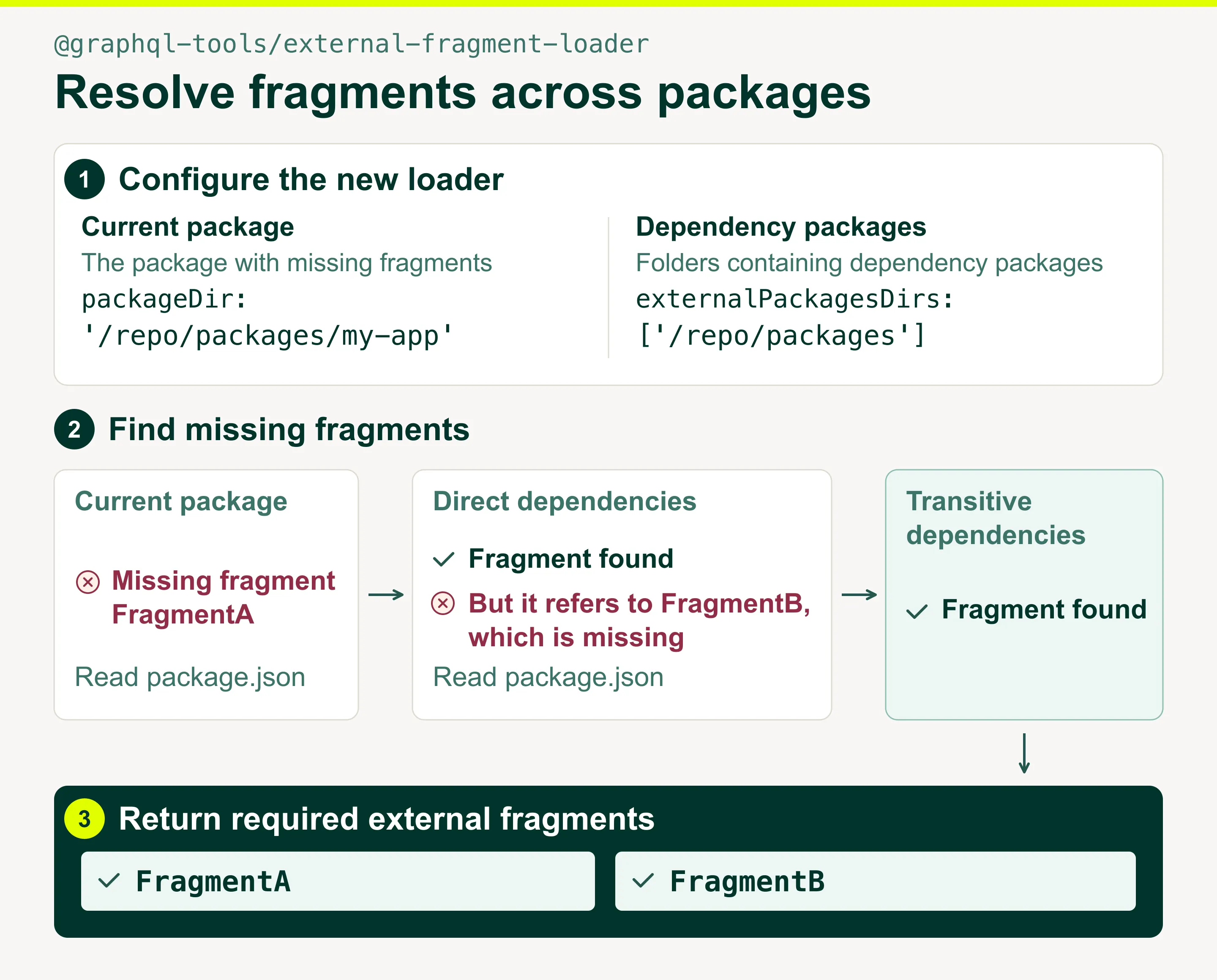
Here is an example configuration for GraphQL Code Generator using the new loader, assuming Codegen runs from the monorepo root:
With this setup, the loader uses the dependencies declared in package.json to find the required
external fragments as they change, without requiring a manually maintained list of files.
See the new loader documentation for more configuration options.
What’s next
We originally built this loader to resolve fragment dependencies before executing GraphQL operations and to support GraphQL Code Generator. Now we’re exploring integrations with GraphQL ESLint and Apollo’s persisted query manifest generator to bring the same fragment resolution to more GraphQL workflows.