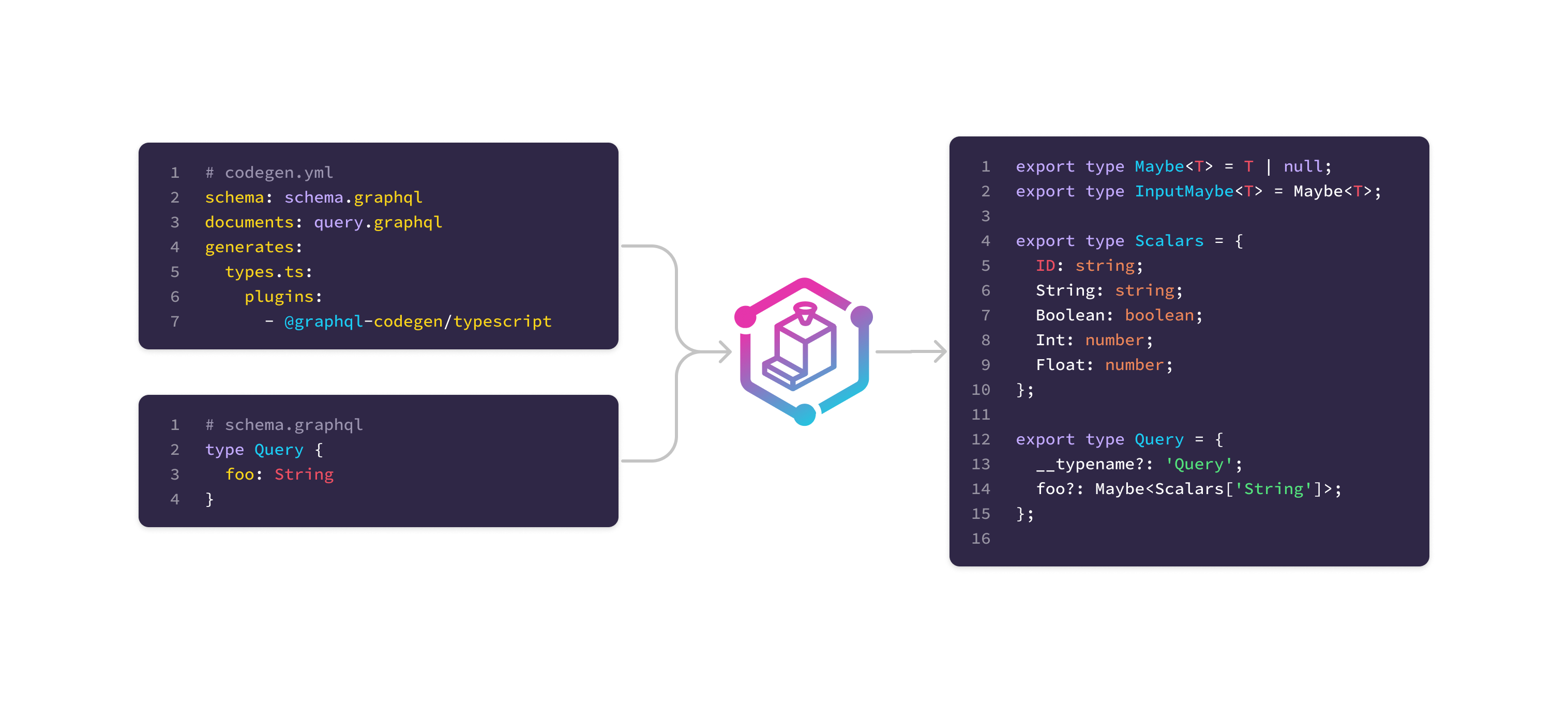
GraphQL Introspection allows fetching the types defined in the target GraphQL API. GraphQL AST allows to navigate through both client-side operations and remote schema types.
In order to generate code and types, GraphQL Code Generator relies on 2 main core concepts of GraphQL:
GraphQL Introspection allows fetching the types defined in the target GraphQL APIGraphQL AST allows to navigate through both client-side operations and remote schema types
Once all GraphQL types (schema types and operations) are identified, GraphQL Code Generator relies on a set of plugins to generate specific code snippets and types.
This process, applied to the @graphql-codegen/typescript plugin, is illustrated below:
Operations and fragments must have unique names
GraphQL Code Generator checks for this automatically and will let you know if you have any conflicts.
Example with @graphql-codegen/typescript
Given the following GraphQL schema:
scalar Date schema { query : Query } type Query { me : User ! user ( id : ID ! ): User allUsers : [ User ] search ( term : String ! ): [ SearchResult ! ] ! myChats : [ Chat ! ] ! } enum Role { USER ADMIN } interface Node { id : ID ! } union SearchResult = User | Chat | ChatMessage type User implements Node { id : ID ! username : String ! email : String ! role : Role ! } type Chat implements Node { id : ID ! users : [ User ! ] ! messages : [ ChatMessage ! ] ! } type ChatMessage implements Node { id : ID ! content : String ! time : Date ! user : User ! } And the following operation (Query) on client-side:
query findUser ( $userId : ID ! ) { user ( id : $userId ) { ... UserFields } } fragment UserFields on User { id username role } And with the following codegen.ts configuration file:
import { CodegenConfig } from '@graphql-codegen/cli' ; const config : CodegenConfig = { schema: 'http://localhost:3333' , generates: { 'types-and-hooks.tsx' : { plugins: [ 'typescript-operations' , 'typescript-react-query' ] }, }, }; export default config; @graphql-codegen/typescript plugin can generate the following TypeScript typings and React hooks files based on defined operations:
// … /** All built-in and custom scalars, mapped to their actual values */ export type Scalars = { ID : { input : string ; output : string ; }; String : { input : string ; output : string ; }; Boolean : { input : boolean ; output : boolean ; }; Int : { input : number ; output : number ; }; Float : { input : number ; output : number ; }; Date : { input : any ; output : any ; }; }; export type Query = { __typename ?: 'Query' ; me : User ; user ?: Maybe < User >; allUsers ?: Maybe < Array < Maybe < User >>>; search : Array < SearchResult >; myChats : Array < Chat >; }; export type QueryUserArgs = { id : Scalars [ 'ID' ][ 'input' ]; }; export type QuerySearchArgs = { term : Scalars [ 'String' ][ 'input' ]; }; export enum Role { User = 'USER' , Admin = 'ADMIN' } export type Node = { id : Scalars [ 'ID' ][ 'output' ]; }; export type SearchResult = User | Chat | ChatMessage ; export type User = Node & { __typename ?: 'User' ; id : Scalars [ 'ID' ][ 'output' ]; username : Scalars [ 'String' ][ 'output' ]; email : Scalars [ 'String' ][ 'output' ]; role : Role ; }; export type Chat = Node & { __typename ?: 'Chat' ; id : Scalars [ 'ID' ][ 'output' ]; users : Array < User >; messages : Array < ChatMessage >; }; export type ChatMessage = Node & { __typename ?: 'ChatMessage' ; id : Scalars [ 'ID' ][ 'output' ]; content : Scalars [ 'String' ][ 'output' ]; time : Scalars [ 'Date' ][ 'output' ]; user : User ; }; export type FindUserQueryVariables = Exact <{ userId : Scalars [ 'ID' ][ 'input' ]; }>; export type FindUserQuery = { __typename ?: 'Query' , user ?: { __typename ?: 'User' , id : string , username : string , role : Role } | null | undefined }; export type UserFieldsFragment = { __typename ?: 'User' , id : string , username : string , role : Role }; export const UserFieldsFragmentDoc = ` fragment UserFields on User { id username role } ` ; export const FindUserDocument = ` query findUser($userId: ID!) { user(id: $userId) { ...UserFields } } ${ UserFieldsFragmentDoc }` ; export const useFindUserQuery = < TData = FindUserQuery , TError = unknown >( dataSource : { endpoint : string , fetchParams ?: RequestInit }, variables : FindUserQueryVariables , options ?: UseQueryOptions < FindUserQuery , TError , TData > ) => useQuery < FindUserQuery , TError , TData >( [ 'findUser' , variables], fetcher < FindUserQuery , FindUserQueryVariables >(dataSource.endpoint, dataSource.fetchParams || {}, FindUserDocument, variables), options ); Now our React components can use the type-safe useFindUserQuery() hook to query the GraphQL API.